
Family & divorce mediation
Parenting, support, property and practical decisions before, during and after separation.
- Parenting schedules & decisions
- Support, disclosure & property
- Separation & changing arrangements

FAMILY · DIVORCE · PARENTING COORDINATION
Private remote facilitative mediation for family, separation and divorce. Work through parenting, finances and the decisions that matter, with a focused process and room to be heard.
CHRISTMAS & HOLIDAY PARENTING TIME · 2026
Christmas Eve, school holidays, travel and handovers. Make space to work through the details before the holiday rush.
You can focus on the holiday schedule without resolving every other issue in your separation.
01 Prompt, focused conversations
02 Privacy with clear boundaries
03 Decisions that remain yours
OUR SERVICES
A full separation, a financial disagreement or one practical parenting issue. Married, separating, divorced and unmarried parents can enquire about a process suited to their circumstances.
Parenting, support, property and practical decisions before, during and after separation.
Practical help with parenting plans, communication and recurring disagreements.
Service in developmentA focused conversation about Christmas, school breaks and the details between two homes.
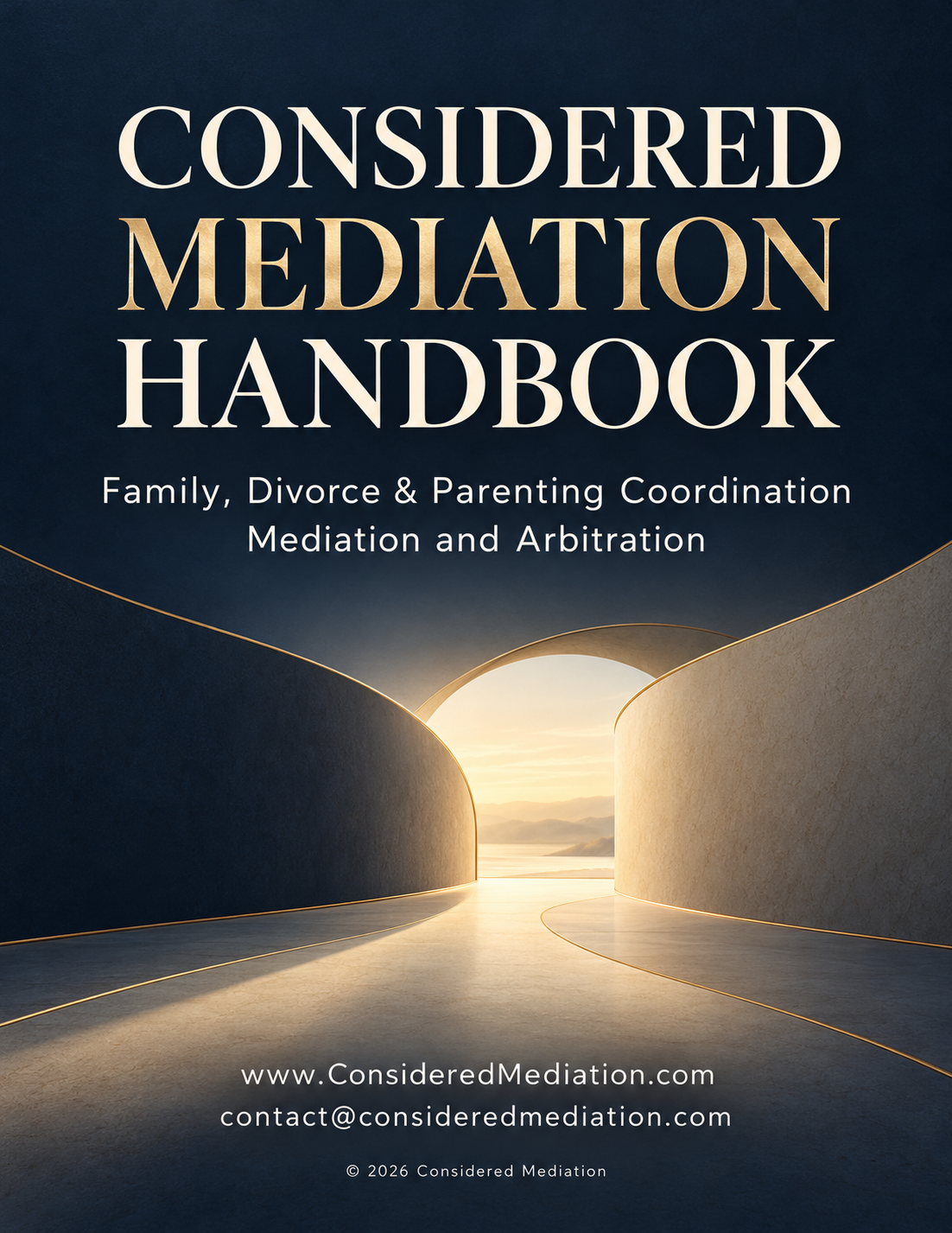
A FREE GUIDE FROM CONSIDERED MEDIATION
Download our free Considered Mediation Handbook. Understand your options, prepare for mediation, and learn about parenting coordination and arbitration, including benefits, limitations and questions to ask before you begin.
Download the free handbook · PDF128 pages · Large print · Practical preparation worksheets
Free to download. No email address required.
THE ISSUES FAMILIES BRING
We help turn a broad disagreement into specific questions that can be discussed, one at a time.
Schedules, decisions, exchanges, activities and information between homes.
Disclosure, child-related expenses, support proposals, budgets and review dates.
Sale or buyout discussions, assets, debts, valuations and practical arrangements.
Dates, traditions, travel, handovers and a plan for the unexpected.
New work schedules, growing children, moves and arrangements that need discussion.
Boundaries, family gatherings, grandparents and practical communication.
HOW WE WORK
Facilitative mediation gives each person space to be heard. We help clarify concerns, explore options and support informed decisions. We do not impose a settlement or give legal advice.
One or both parties may have a lawyer assist. Self-represented participants are encouraged to obtain independent legal advice before, during and after mediation.
Explore the full processPrivate intake helps us understand the concerns, assess suitability and agree on how to work together.
Clarify the issues, explore the interests beneath them and consider practical options.
Identify agreed points and outstanding questions. Allow time for independent legal advice before proposed terms are signed or relied on.
THE BENEFITS OF PRIVATE MEDIATION
For suitable matters, a private process can help you address decisions sooner, focus the discussion and work toward arrangements that fit your family.
Arrange a focused conversation around your family’s deadlines. Ask for the earliest available intake and session, subject to readiness and suitability.
Discuss sensitive issues in sessions that are not open to the public. Confidentiality, its exceptions and any permitted reporting are explained before engagement.
Explore options, take advice and decide whether to agree. You can address one urgent practical issue or a wider separation agenda.
Clear scope and fees, remote access and a process adapted to the participants. Timing, costs and outcomes depend on the circumstances.
Why choose private mediation?
ABOUT CONSIDERED MEDIATION
Considered Mediation is led by Waldemar A. (Andrew) Igras, a former Alberta family-law litigator with extensive experience of difficult negotiations and emotionally charged disputes.
His education includes a Dispute Resolution Certificate from York University’s School of Continuing Studies, including civil-mediation coursework.
He is also completing York University’s Certificate in Family Mediation — in progress. The program covers facilitative mediation, family law, family relationships, screening for domestic violence and advanced mediation practice. About the York program ↗
Completion of the family mediation certificate is planned before the parenting coordination service opens. That service remains in development while its scope and professional requirements are confirmed.
A parenting disagreement may reflect concerns about stability, fairness or a child’s changing needs. A financial disagreement may involve uncertainty about the future. We look beyond the opening demand to understand what needs to be addressed.
He draws on nearly 20 years of legal experience and now focuses entirely on research, writing, mediation, arbitration and parenting coordination. He does not currently practise law, and he encourages readers and the people he works with to get independent legal advice where they live.
Our role in mediation is impartial. Participants make their own decisions. Parenting coordination remains a planned service, as described on this site.
Training put into practice: preparation, impartial listening, managing difficult dynamics, exploring options and recording clear next steps.
BEFORE YOU BEGIN
Answers to common questions about preparation, participation and what happens next.
More about our approachSessions are not open to the public. The written mediation agreement explains confidentiality, its legal limits and any information that may be disclosed. A settlement or later court filing may have a different status. Read about privacy and confidentiality.
A focused session may be arranged without waiting for a contested hearing date. Actual timing depends on availability, both participants’ intake, necessary disclosure and any legal advice. Ask about current dates. Mediation does not suspend court deadlines or guarantee settlement.
Yes, a suitable mediation can focus on a defined holiday issue. You do not need to settle every financial or parenting question in the same session. Explore the holiday service and checklist.
No general income rule requires you to buy private mediation. Eligibility for free or subsidized services depends on the program. Compare Ontario and Alberta options.
We use facilitative mediation. The mediator helps clarify concerns, explore options and keep the conversation productive, without imposing a result or giving legal advice. Participants decide whether to agree, supported by their own independent advice.
Yes. One or both parties may have their own lawyer assist with preparation, participate in sessions by arrangement, or advise between sessions. If only one party has a lawyer, that lawyer does not advise the other party. We discuss roles, fairness, access to advice and any support person or interpreter at intake.
You can enquire without retaining a lawyer for your whole matter. We encourage you to obtain independent legal advice before, during and after mediation, especially before signing or relying on proposed terms. Ask a lawyer about advice or document review for a defined part of your matter. Explore legal-help resources.
A short chronology, the main issues, the documents that matter and a clear sense of your priorities are a useful start. Consider what you need to learn, which options you could discuss and what you may do if agreement is not reached. We will identify appropriate document-sharing arrangements during intake.
The format is discussed beforehand. Joint sessions, separate private meetings, shuttle discussions or virtual arrangements may be considered. The appropriate choice depends on suitability, safety, practical needs and the participants’ circumstances.
Ask for the earliest available intake and a written fee proposal. We confirm the preparation, session time and follow-up included, how extra time is approved, payment arrangements and cancellation terms. Booking follows suitability checks and agreement on the terms.
We can identify the points resolved and the issues still open. The status of any written terms, any further information needed and the next steps should be clear. For family matters, seek independent legal advice about proposed agreements and existing orders.
READ. REFLECT. PREPARE.
Explore the DivorceNexus support calculators, official information and books to help you prepare for the next conversation.
Explore child-support calculations and spousal-support illustrations to prepare questions for mediation or independent legal advice.
Open the DivorceNexus calculatorsEstimates and illustrations, not legal advice. Check the calculator’s current coverage and assumptions.
FREE HANDBOOK · 128 PAGESOur large-print guide to family and divorce mediation, parenting coordination and arbitration, with practical preparation worksheets.
Download the free handbook · PDF ↓INFORMATION. FORMS. INDEPENDENT ADVICE.Find Justice Canada and Alberta resources, provincial family-law information, official court forms and places to look for independent legal advice.
Open the family resources page ↗BOOKS & IDEASExplore books by Andrew Waldemar on separation, parenting, family life and the decisions that shape what comes next.
Visit ConsideredPress.com ↗For further background: Justice Canada’s guide to family dispute resolution
YOUR NEXT STEP
Tell us the general issue, your province and any important dates. We will discuss suitability, current availability and the scope and fees before you decide whether to proceed.
Enquiries are received through Considered Press. Please wait for appropriate arrangements before sending confidential documents. The button opens your email app.